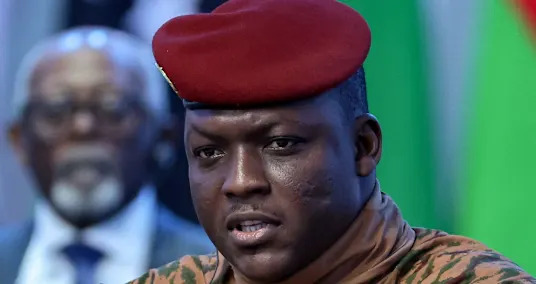
Democracy "kills" and the people of Burkina Faso must "forget" it, the country's military ruler has said in an interview aired on state television.
Capt Ibrahim Traoré, who seized power in a coup three years ago, suggested most Africans do not want the system of democracy and that Burkina Faso had its own, alternative approach, without giving details.
Traoré initially pledged to restore democratic rule to the West African country by July 2024, but two months before this deadline, the junta announced it would extend its rule for another five years.
In January, the authorities announced a ban on all political parties as part of a plan to "rebuild the state".
In Thursday night's interview, Traoré said: "People need to forget about the issue of democracy. Democracy is not for us.
"Look at Libya, this is an example close to us," said the 38-year-old, who casts himself as a revolutionary leader standing up to Western imperialism.
Libya was ruled autocratically for four decades by Colonel Muammar Gaddafi, who oversaw a brutal regime while also providing Libyans with subsided housing, free education and free healthcare.
He was killed during a rebellion assisted by Western military intervention. The north African country has since failed to hold elections and is split between two rival administrations, along with numerous armed groups.
"Wherever they [Western powers] try to establish democracy in the world, it's always accompanied by bloodshed," Traoré said in his interview.
While there has been a spate of military takeovers in recent years, most African countries do still hold regular elections, even if some are criticised as being rigged in favour of incumbents. Two military leaders - in Gabon and Guinea - have organised elections which they have gone on to win.
Traoré also addressed the dissolution of political parties, saying he considered them to be divisive, dangerous and incompatible with the revolutionary protect.
"The truth is, politics in Africa – or at least what we've experienced in Burkina - is that a real politician is someone who embodies every vice: a liar, a sycophant, a smooth-talker," he said.
The junta leader did not propose an alternative system, but said: "We have our own approach. We're not even trying to copy anyone else. We're here to completely change the way things are done."
He emphasised building a new system rooted in sovereignty, patriotism and revolutionary mobilisation, with traditional leaders and grassroots structures playing a central role.
In a wide-ranging interview, he also emphasised the importance of economic and military self-reliance, as well as hard work, saying that working six- or eight-hour days would not enable Burkina Faso to catch up with richer countries.
Traoré has suppressed dissent during his rule, cracking down on the opposition, media and civil society groups. His government has even been accused of punishing critics by sending them to the front-lines of the war against Islamist militants.
Despite this, Traoré has gained a huge following across the continent for his pan-Africanist vision and criticism of Western influence.
Burkina Faso, like its junta-led neighbours Mali and Niger, has moved away from working with Western countries, especially France, in its fight against Islamist militants, which have waged a decade-long insurgency in the region.
All three have instead turned towards Russia for military assistance, but the violence has continued unabated.
On Thursday, a report by Human Rights Watch (HRW) said more than 1,800 civilians have been killed in Burkina Faso since Traoré seized power in 2023.
The publication attributes two-thirds of the killings to the military and allied militias, with the rest blamed on Islamist militants.
Additional reporting by Omega Rakotomalala
You may also be interested in:

Go to BBCAfrica.com for more news from the African continent.
Follow us on Twitter @BBCAfrica, on Facebook at BBC Africa or on Instagram at bbcafrica
BBC Africa podcasts
LATEST POSTS
- 1
 China’s new condom tax will prove no effective barrier to country’s declining fertility rate
 - 2Divorce filings, feuds and legal trouble: The 'Mormon Wives' drama keeps piling up
- 3Mountain Trekking on a Tight spending plan: Tracking down the Right Bicycle
- 4Nations for Youngsters to Visit
- 5Zelensky sees new Russian attack threat from Belarus




- Israel says soldiers wounded in Gaza fighting amid fragile truce
- US measles cases surpass 2,000, highest in 30 years: CDC
- Winter storms blanket the East, while the U.S. West is wondering: Where’s the snow?
- The Main 20 Photography Instagram Records to Follow
- Oil, energy and food: Which countries in Europe are most exposed to higher food prices?
- Grasping the Qualifications Among Separation and Dissolution
- James Webb Space Telescope's mysterious 'little red dots' may be black holes in disguise
- Paris Agreement target off the table, report says
- IndiGo lands IATA chief Willie Walsh as new CEO