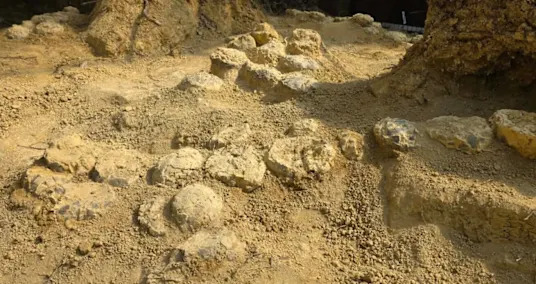
Imagine brushing away 72 million years of sediment and uncovering hundreds of dinosaur eggs, their shells still intact after surviving everything from asteroid impacts to ice ages. That’s exactly what happened at the Mèze fossil site in southern France, where paleontologists working through the winter months revealed one of the world’s most significant dinosaur nesting grounds. The discovery feels like stumbling upon a prehistoric treasure trove—if ancient titanosaurs had curated their own museum exhibits.
Ancient Nursery Preserved in Stone
Museum director calls the find an unprecedented gathering of fossilized eggs.
Alain Cabot, director-curator of the Musée-Parc des Dinosaures de Mèze, described the discovery as an “exceptional concentration” spanning 15 square miles of Upper Cretaceous rock. Over 100 eggs became visible within weeks of careful excavation, with many retaining their internal structures—a paleontologist’s equivalent of finding unopened time capsules. The fossil-rich layer extends far beyond the current dig site, suggesting this ancient maternity ward holds many more secrets waiting 70-72 million years for their moment in the spotlight.
A Snapshot of Cretaceous Family Life
Titanosaurs dominated the nesting ground, but smaller dinosaurs also called it home.
The eggs primarily belong to titanosaurs—those massive long-necked herbivores that would dwarf modern elephants. Yet scattered among these giants are smaller treasures:
Eggs from ankylosaurs
Tiny theropods, including the rare Prismatoolithus caboti, one of the smallest carnivorous dinosaur eggs ever discovered
Picture a Cretaceous suburbia where different species chose the same prime real estate for raising their young, much like how modern birds flock to protected wetlands during nesting season.
Modern Wonder Meets Ancient Mystery
Social media buzz reflects enduring fascination with dinosaur discoveries.
The museum’s Facebook announcement exploded with over 1,500 reactions and hundreds of shares, proving dinosaurs still captivate imaginations across generations. Visitors can now observe the ongoing excavation in person, watching scientists methodically reveal creatures that nested here when flowering plants were still evolutionary newcomers. The preserved floodplain environment—where periodic flooding rapidly buried eggs under protective sediment—created perfect fossilization conditions that geological time couldn’t destroy.
Each egg represents a moment frozen in deep time, waiting 72 million years for someone to rediscover the story of these ancient parents and their hopes for the next generation.
From the coolest cars to the must-have gadgets, GadgetReview’s daily newsletter keeps you in the know. Subscribe - it’s fun, fast, and free.
LATEST POSTS
- 1
 Astronauts beam home Christmas wishes from International Space Station: 'I think we may be orbiting a little higher than Santa' (video)
 - 2Explainer-What will change with the US reclassification of marijuana?
- 3What is IDF's view on pontential long-term occupation of southern Lebanon?
- 4Manual for Tracking down Spending plan Agreeable Travel Objections
- 5Cyber Monday streaming deals 2025: Grab the Disney+ Hulu bundle for only $5 and save over 60%





- Artemis 2 astronauts fly around the moon in record-breaking lunar loop by NASA
- Ghassan Al-Duhaini to replace Abu Shabab as Popular Forces leader in Gaza
- Verdicts against social media companies carry consequences. But questions linger
- Miss 'Stranger Things' already? Here's how you can get your Upside Down fix in 2026 with spinoffs, games and more
- Lebanon says Israeli strike killed 13 people near Palestinian refugee camp
- A definitive Manual for 2024's Most In vogue Wedding Dresses
- Israel scales back use of top missile interceptors as Iran barrages persist
- 'The Real Housewives of Rhode Island' 1st teaser trailer unveiled: Which Bachelor Nation star is part of the cast? And when does it premiere?
- Step by step instructions to Look at Compact disc Rates: A Thorough Aide